Replacing Hay with Complete Horse Feed

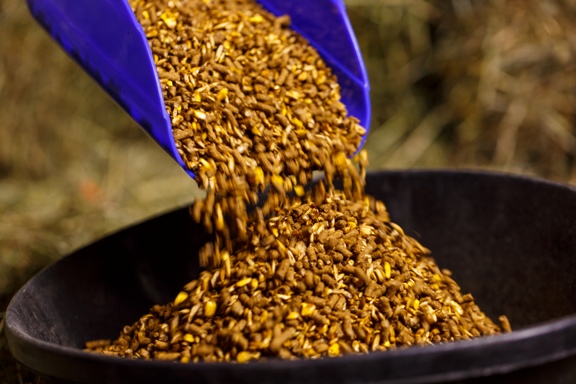
A large boarding barn asked me to stop out and review their feed program as they were going to be making a change. The farm has over 100 horses in their care, and wanted to review the proposed change prior to placing their order.

They were currently feeding an economy pellet with an average feed rate of 6 pounds per horse per day. The new product the owner was considering is a mid range product that contains added fortification, as well as biotin and yeast culture. This would be a great enhancement to their current feed program, especially since their forage was not the best this year.

As I visited with the farm owner he explained that he was running dangerously low on his hay supply. He had priced hay from various sources, but the costs were excessive. He felt that if he transitioned the farm to a complete feed product, he could reduce his hay feeding rate by 50% per horse, and just use the complete feed.

He stated that even though the product was more expensive per ton than his current feed, but he would be saving money by feeding just the 6 pounds of complete feed per day. It was at that point that I realized he had not read the recommended feed rates for the product he was considering.

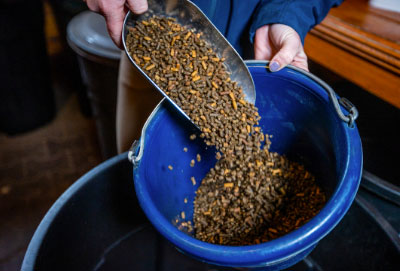
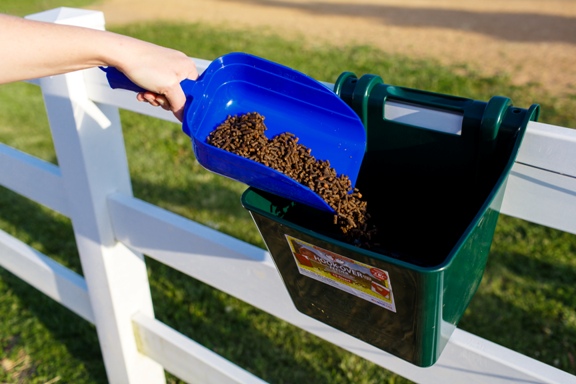
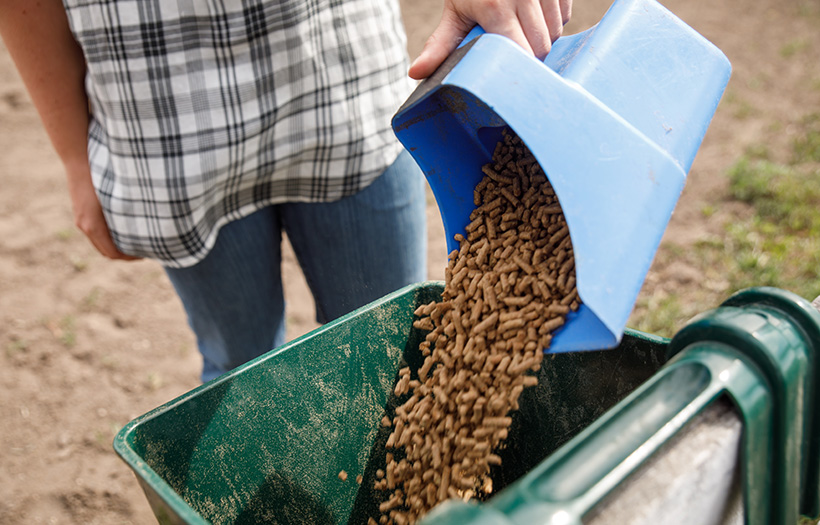
I agreed with the owner that complete feeds are an excellent choice to help balance a diet when forage is not readily available, or horses have a problem eating hay. I then went on to explain that he could reduce his hay feeding rate by 50% per horse per day, but he would need to compensate for the difference with additional complete feed beyond the 6 pound level of his traditional grain source.

Moral of the story: Complete feed products are great for horses with limited or no hay diets, but be sure you are following the recommended feed rates listed on the tag!

Your thoughts? Please leave a comment.

Posted in Feed Costs, Hay/Pasture
Tagged as , , ,

Allergy, Intolerance, or Irritation?

Horses experience a variety of situations related to plants, insects and chemicals that can be the source of discomfort or a variety of clinical symptoms.

These reactions can be broken down into several areas:

  • A feed or a food allergy is an abnormal immune system reaction, generally to a specific protein in a specific ingredient in the feed or the food.
    • This may result in what we call uticaria (welts), plaque, bumps or hives that we see on the skin. Sometimes called protein bumps, these are not a reaction to too much protein, but are a reaction to a very specific protein. (Equine Clinical Nutrition, Dr. Lon D. Lewis, Williams & Wilkins, 1995 p 20.)
    • This protein may come from a feed ingredient, but also may come from ingestion or inhalation of other material or something like insect bites.
    • One horse in a herd may develop an allergic reaction while other horses are not affected.  Identifying the specific allergen may require exclusion feeding or highly specific allergy testing.
    • In humans, the extreme example is something like a peanut allergy where a very small quantity can create a life threatening situation.
  • A feed or food intolerance is not the same as an allergy, although there may be some similar symptoms.
    • An individual is not able to properly digest a specific ingredient, which can result in digestive disturbances.
    • Human examples may include such things as lactose intolerance or gluten intolerance.  This has not been well identified in horses, but may be possible.
  • An irritation may be caused when the horse comes in contact with specific substances that cause tissue irritation.
    • A horse that is sensitive to the chemicals in a particular grooming product or fly spray may break out or experience skin irritation and loss of hair.
    • Insect bites may cause both an allergic response and a surface irritation.
    • Chemical irritants from plant, insect or synthetic sources may cause skin surface reactions.

Unusual skin symptoms or digestive disturbances may require careful observation (and sometimes a bit of luck) to determine the underlying cause.  It may be very useful to work with your veterinarian to determine the exact condition and search for potential causes.

Your thoughts? Please leave a comment.

Posted in Care and Management
Tagged as , , ,

Stretching Your Horse Hay Supply

This article is courtesy of Krishona Martinson, PhD, University of Minnesota.

Most horse owners have noticed that the price of feed (both hay and grain) has increased.  At a hay auction in Sauke Center, MN, the 10-year average for horse quality hay (101-125 relative feed value) is $100 a ton; however, this year (2013), that same hay is averaging $220/ton.  There are several key factors that have contributed to these increases, including extreme weather patterns (i.e. drought), high oil prices, currency fluctuations, a struggling economy, and a market that makes growing corn and soybeans more profitable and less risky compared to hay.     

Horses have evolved on diets composed entirely of forage. Therefore, forage should be the primary component of a horse’s diet (at least 2/3 of their diet). Thus, horse owners, unlike other livestock owners, have few options other than forages to use to meet their horse’s nutritional requirements. 

However, there are management practices that can help horse owners ride out high feed prices:

  • Horse owners should take a critical look at equine body condition and maintain a body condition score of 5 (on a scale of 1 to 9).
  • Horses that maintain their weight on forage-only diets do not usually require any concentrate (grain).
  • A well-formulated ration balancer (concentrated vitamin and mineral mix) will ensure that vitamin and mineral needs are being met when dried hay is the sole dietary component.  Even the best, nutrient-dense hay will be deficient in essential vitamins and minerals, including vitamin E, copper, zinc, iodine, selenium and manganese (in alfalfa hay).

While all forage offered to horses should be free of dust, mold, weeds, and foreign debris, the nutrient density of the forage offered can vary depending on the type of horses being fed. Forage selection should be based on horse needs, as there is no one forage best suited for all classes of horses.

  • For example, providing nutrient dense forage like vegetative alfalfa hay to ‘easy keepers’ can create obesity issues; however, that same hay would be a good option for a performance horse with elevated nutrient requirements.
  • Have hay tested for quality to help determine how much and what type is best to feed to individual horses.
  • Keep in mind that higher quality hay usually demands a premium price and such hay is not needed by all groups of horses. 
  • Finally, older hay, if stored properly, is usually a great option for horses. 

Plan ahead and know how much hay you need. Horses eat roughly 2 to 2.5% of their body weight in feed (hay plus grain) each day.  For example, an average 1,000 pound horse will eat around 20 to 25 pounds of feed daily, plus water. Weighing the amount of feed offered will help to avoid over-feeding. 

When calculating hay needs, make sure to account for wasted hay. In a recent study conducted by the University of Minnesota, feeding round-bales to horses without a round-bale feeder resulted in 57% waste, while using different feeders ranged from 5 to 33% hay waste.  Although feeders do cost money, all round-bale feeders tested paid for themselves (due to reduced amounts of waste) in less than 10 months with hay valued at $200/ton.  A Texas study found that when horses were fed in a box stall, waste from feeding small square bales off the ground was 7% compared to only 1% waste when hay was fed in a feeder.  Using a feeder, regardless of bale-type, is essential to reducing waste and stretching your hay supply. 

Finally, have a good working relationship with a hay supplier to ensure a consistent and reliable source of hay.  Consider adding hay storage space to reduce the effects of price and seasonal fluctuations.  For example, hay is sometimes more expensive in the winter vs. the summer.  Buy hay early (do not wait for second or third cuttings) and budget for the price increase by re-evaluating how many horse you can afford to feed.

4 Comments

Posted in Feed Costs, Hay/Pasture
Tagged as , , ,

How Much Do I Feed My Senior Horse?

Most of us have that one special senior horse – maybe he’s been with us for a long time, or maybe you’ve rescued him in his old age from a bad situation. Whatever the case, most people have had some experience with the special nutritional needs of geriatric horses. Senior feed usually fills this bill very well – soft pellets they can easily chew, lots of digestible fiber, a little extra protein to maintain muscle mass, and added fat for body condition.  It may surprise you to know, however, that the majority of people who feed a senior ration are not feeding it correctly. One of the most common mistakes I see horse owners make is underfeeding their senior horse.

Senior horses can be categorized two ways – those that can eat hay and those that can’t. Because most senior feeds on the market today can be fed as a sole ration (ie 16-18 lbs. per day to a 1,200 lb. horse in light work) they have to be formulated in such a way that a horse eating this much of the feed won’t be overdoing the concentration of vitamins/minerals, etc. Therefore, even if your horse is able to eat hay along with the senior feed, you still need to feed the minimum amount (5-7.5 lbs. for a 1,000 lb. horse), to even begin to meet the fortification requirements that your horse has in advanced age. Below is a guideline for correct feeding amounts for senior horses.

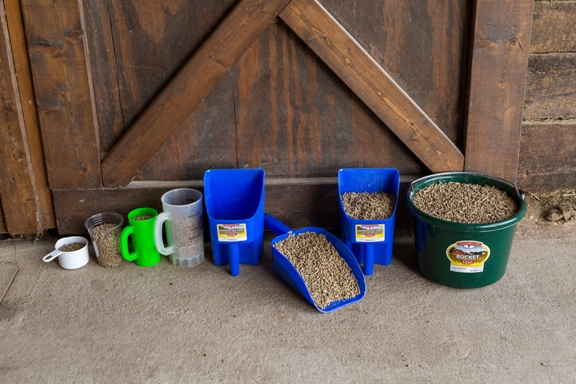
TIP: Put away those coffee cans and get out your scale!!!

If your horse can eat hay, the minimum amount of senior feed he should have per day for maintenance is:

800 lb. horse: 4-6 lbs.
1000 lb. horse: 5 – 7.5 lbs.
1200 lb. horse: 6 – 9 lbs

If your horse depends solely on senior feed and cannot eat hay, the minimum about of senior feed he should have per day for maintenance is:

800 lb. horse: 10 -12 lbs.
1000 lb. horse: 12-14 lbs.
1200 lb. horse: 14 -16 lbs.

5 Comments

Posted in Feeding Management, Senior Horses
Tagged as , , ,

Body Condition Scoring Horses – a Hands-On Project!

Most of you met our old horse, Fred, in an earlier blog post I did. Well, I am happy to report that Fred is flourishing in his new home and we like to think that he likes it here quite well.

However, our temperatures have been getting quite cold, in the teens and  mid 20s for highs, and I was concerned with how well Fred was holding his weight. The snow cover has been consistent, so I knew he was not doing too much in the way of grazing. He gets about 1.75% of his body weight in hay each day along with a ration balancer, but with his age and the cold weather I wanted to see how he was really faring.  With the short daylight hours of mid winter fully upon us, it is hard to see his exact condition during the work week when we are gone during the day.

So last Saturday I went out to check on him during daylight hours and was pleased to see that he looked pretty good – pretty fluffy with all that winter coat – but still pretty good from where I was standing (about 10 feet away). I went into the pasture and put his halter on and began to feel over his ribs and topline. Contrary to what he looked like from a distance I determined that underneath all that hair, Fred had lost some weight. I could feel his ribs fairly easily and after palpating along his topline I could tell he was just starting to lose condition there as well.

Viewing him from the fence was one thing, but getting my hands on him was a different story and I realized we needed to change his diet and replace his ration balancer with some senior feed to get additional calories into him. We are in the process of transitioning him onto his new feed and so far he is doing great.

I learned a valuable lesson, though – when evaluating the body condition score of your horses (especially under all that winter hair) you have to get your hands on them! I now have a reminder set on my calendar to body condition score Fred every month. I don’t want to have any springtime surprises when all that hair sheds off!

Your thoughts? Please leave a comment.

Posted in Care and Management, Changing Horse Feed, How To, Senior Horses, Weather-Related Feeding

“It Must Be the Pellets!”

A couple weeks ago, I transitioned a large breeding farm from textured feed to pellets. Despite the farm manager’s reluctance, the feed program was changed. The horses were doing well and everyone seemed pleased.

Late one afternoon I received a frantic call from the farm manager. She said some of the horses were drooling and acting strange. She said they had just been fed an hour earlier and “it must be the pellets”. It sounded like possible choke issues.

I reviewed the feeding procedures with the manager, and she had fed hay prior to the concentrate. I suggested she keep a close watch on the horses and contact their veterinarian. About an hour later the manager called me again and said the choke issues had subsided, but now a few of the horses were presenting colic symptoms. She was awaiting the veterinarian, and again stressed “It must be the pellets”.

The veterinarian treated the horses, questioning water consumption, and feed changes. The manager called me to tell me that all seemed quiet. I encouraged her to keep me advised of any changes. A few hours later I received a call that two horses were on their way to the veterinary hospital. This time the manager did not hold back about her concern with the pellets.

The next morning I called the farm manager to check on the horses. She told me that both mares had colic surgery. I asked if the veterinarian had determined the cause, and was surprised by the answer. For the past few days the horses were not getting turned out due to the cold weather. While inside the horses did not receive any additonal hay to compensate for the round bales they consumed during turnout. With the lack of chew time and boredom, the horses had eaten their pelleted bedding, which had in turn caused the colic.

Today’s lesson: Feeding 1 ½ to 2% of a horses body weight per day in forage really is essential for a healthy horse!

1 Comment

Posted in Care and Management, Colic
Tagged as , , ,

Starch Levels in Feed

In my previous blog post on this topic, we explored the role starch plays in the horse’s diet.  After (hopefully) warming you up to the idea of how useful this nutrient can be, I’d like to now dig in to how you can compare and contrast the varying levels of starch (and sugar*)  in feeds and hopefully this information will  help you compare and contrast to choose the best option for your horse.

Contrary to what you may have been told or read, most horses can tolerate a moderate level of starch each day.  If you have a horse that has been diagnosed with a form of equine metabolic disease, you will need to limit your horse to a ‘low’ controlled starch and sugar diet….which includes forage (hay and pasture).  Fructans, the sugars in forages, are too often overlooked when assessing the total diet of an EMS horse.  

Even if your horse has not been diagnosed with EMS, it is still important to understand the starch level in his diet and take it into consideration for your overall program. Think you know how to compare starch levels from one feed to another?  You might be surprised to find out that a bit of math is required. Simply comparing the percentage of starch on feed tags doesn’t quite tell the whole story.  To get to a true comparison, it is important to factor in the recommended feeding rate, which is, after all, what the horse experiences.

Let’s compare two feeds that are marketed as ‘low starch’; one has a starch maximum guarantee of 7% while the other has a maximum of 11%.  Pretty easy to tell which one is the lowest, right? 

Look beyond the percentage to find what's really in the feed

Not quite.  For our example,  let’s say we have a 1,000 pound horse at maintenance level activity.  Feed A, with 7% starch is recommended to be fed at a rate of 6 pounds per day, meanwhile, Feed B has a starch maximum of 11% and is recommended to be fed at a rate of 2.5 pounds per day.

Here is the formula to use:  Starch % * pounds fed/day *454 (converts to grams) = grams of starch fed/day


Applied to our example scenario, here’s how the math works out:

Feed A:  7% starch x 6 pounds fed x 454 = 190.68 grams of starch per day.

Feed B: 11% x 2.5 pounds of feed x 454 = 124.85 grams of starch per day.

Wow – a big surprise!  Not only is the 11% starch feed actually lower in grams of starch per day than the 7% product, the difference is actually rather significant given how different the percentages were.   It is important to keep in mind that it all comes down to what your horse actually ingests, so understanding the recommended feeding rate in pounds and then weighing your feed to hit that mark is what will make the difference.

It’s also important to understand that horses who do not experience a form of EMS have a higher tolerance for starches and sugar in their diet…and in fact, the performance horse will actually need those nutrients to support their activity levels.  It all comes to down to understanding what’s in your feed and how much you’re giving them.

*Though this blog article addresses ‘starch’ the same principles apply to determining the amount of other nutrients in a feed. 

Your thoughts? Please leave a comment.

Posted in Care and Management, Diseases and Disorders, Feeding Management, Horse Nutrition, How To, Starches & Carbohydrates
Tagged as , , , , ,

In Defense of Starch

Like a celebrity on a downward spiral, starch has been getting a lot of press in the last few years…and most of it negative.  Unlike celebrities, starch doesn’t gain anything from the media exposure.  Although it may be unpopular, I’d like to take a moment to say a few words in defense of starch; a (recently) under appreciated, yet useful nutrient in horse diets.

But first, let’s start with what it is.  Starch is a complex chain of sugar molecules, which is the main source of energy for plants.  It is stored within the cell walls of the plant and therefore, considered a nonstructural carbohydrate (NSC).  Starch in horse feeds are most commonly sourced through grains such as oats, barley, corn, rice or wheat and the co-products of these grains such as corn distillers grains, rice bran or wheat midds. 

Glycemic response of oats and controlled starch diets, in horses

When ingested, starch molecules are broken down into smaller sugar molecules (glucose) that are readily absorbed. With the help of insulin, the glucose in the bloodstream is ‘picked up’ by muscles and other tissues to either be used to support activity or stored (as glycogen) for future energy needs.  Hard working and active horses need glucose and glycogen to support their activity levels and recovery from activity.   It’s also worth pointing out that NSC’s are a very efficient pathway to providing energy to the horse and to aid in muscle recovery (glycogen repletion), particularly in horses performing athletic activities.

Most horse owners know that too much starch at one time can overwhelm the horse’s digestive system.  That excess, undigested starch could leak into the hind gut where it can rapidly ferment, leading to an overproduction of gas and lactic acid, which in turn, could cause gas colic and/or acidosis which could then lead to laminitis or other issues.

You’re probably wondering, if it’s needed by horses for energy, but also potentially dangerous then how does the horse get what he needs without wreaking havoc?  The answer lies in the QUANTITY of starch consumed in each meal.

The majority* horses can tolerate a moderate level of starch each day.   This is not to say, all at one time.  There is a big difference!  Consider the digestive system of a horse to be like a waterway – it can tolerate a certain quantity of water running through it (or in this example starch) but if there is too much at one time, the water overflows and goes where it is not supposed to go.  Same with starch in the digestive system – the body can handle a moderate quantity of starch released at a controlled rate, but too much at one time (or from too big of a meal) and the whole system gets out of whack. 

I offer up one last nugget to consider: oats – the long-time staple of ‘safe’ feedstuffs for horses, actually contains approximately 40% starch. Now there’s something to think about…

So, in defense of starch, I’d just like plead the following.  When consumed in moderate amounts/meals,  frequently over time, starch is a useful and practical source of energy for most horses. 

In my next post, we’ll talk about how to evaluate starch levels in feeds.  Stay tuned for more….

*Horses diagnosed with a form of Equine Metabolic Disease (EMS) require a diet that is closely managed to control and limit the amount of NSC (including fructan from forage) in their diet. 

4 Comments

Posted in Digestive System, Feeding Management, Horse Feed, Ingredients in Horse Feed, Starches & Carbohydrates
Tagged as , , , , ,

What Makes it ‘Premium’ Nutrition?

Aside from price, how do you know if a feed that is advertised as premium nutrition, really is? Here are some tips to help you decode the premium puzzle.

First, a word about forage….Forage, being hay and/or pasture, should make up the majority of your horse’s diet.  Therefore, the amount of effort and investment you make in your feeding program should be heavily weighted toward offering your horse the best quality forage you have access to.  Your feed selection should complement your forage. Feed or supplemental fortification should fill gaps in forage nutrition, but the most important aspect is the quality of forage, as that makes up the majority of your horse’s source of energy.  Always consider your horse’s forage first and foremost.

What is on a tag?  Onto the feed concentrate; the most important aspect of your feed choice is the nutrients the feed will provide for your horse.  When you buy premium nutrition, you expect to get premium results…but, what you pay for may or may not be what you get.  So how can you tell?

First, check the tag for guaranteed analysis of nutrients.  A premium feed will be formulated to deliver your horse the optimal nutrition for their age and activity level.  Each horse varies to some degree in their metabolism and requirements, but in most cases, optimal nutrition will be formulated to provide the most digestible nutrients in levels that ensure your horse makes the most of every meal. 

With regard to nutrient levels, is more actually better? Not always.  Sometimes more is just more.  Take into consideration minerals.  Mineral fortification of a diet is only as good as the amount that is absorbed, so having more copper, zinc or manganese listed on the tag doesn’t mean that your horse is making use of it all.  Look for key words that indicate digestibility; for minerals, ‘organic’ means the mineral is tied to an amino acid and is readily absorbed.  For proteins, look for guaranteed levels of ‘lysine’, ‘methionine’ and ‘threonine’.  These are the protein components that matter most to your horse.  Sometimes more is just…well more.

In the scoop…Another way to compare feeds is to determine y how much you have to feed to give your horse the optimal level of nutrients guaranteed on the tag.  Most feed companies formulate their rations to provide an amount of digestible energy (DE) which determines the rate (or amount) which they recommend you feed.  All other nutrients, such as the vitamins and minerals, are concentrated based on that feeding rate.

For example, you have two different feeds you are considering for your horse who is at a ‘maintenance’ level energy requirement (meaning to keep his body condition score at or about a 6).  Feed A recommends you give him 2.5 pounds per day, while feed B recommends you feed a minimum of 4 pounds per day.  Keep in mind that  if you feed less than the recommended 4 pounds of feed B, not only will your horse not get the DE for his activity level, he will also not get the optimal amount of vitamins, minerals and amino acids (if they are guaranteed). Keep in mind percentages on the tag are only as good as the rate at which they are fed.

Functional Ingredients…..There are ingredients that provide the diet with big nutrients such as fat, fiber and protein.  There are ingredients that provide micro nutrients, such as minerals and vitamins.  And then there is a whole other class of ingredients are called ‘functional’ ingredients.  These items are intended to enhance the efficiency or digestibility of the feed, meaning your horse gets more out of every bite.  Consider prebiotics and probiotics for example.   Through research, both of these functional ingredients have shown to enhance the digestibility of many nutrients and improve overall gut health.  The addition of prebiotics and probiotics to a diet is intendedto aid your horse in getting that optimal nutrition for a premium result!

Valid Research… One last thing to take into consideration; a feed brand or company that has a research program is far more likely to understand the digestibility of ingredients and the nutrient requirements of the horse, versus a company that does not conduct research.  Many aspects of optimal nutrition, such as understanding digestibility, aren’t found on a tag, but are proprietary to the researching company.  Before you consider a feed that is advertised ‘just as good as, only cheaper’, consider what makes the real deal.  In most cases, a company that copy-cats a popular product doesn’t get you to the same level of quality, premium nutrition as the original.

So, is it really a premium feed?   Check the tag to find out.  Armed with this information, you can answer this question for yourself!

Your thoughts? Please leave a comment.

Posted in Feed Costs, Feeding Management, Horse Feed, Horse Nutrition, How To
Tagged as , , , ,

Winter Condition Check to be Ready for Spring

Bay horse in a snow fallCold weather, particularly below freezing temperatures, requires that owners pay careful attention to their horses to make certain that the horses stay in good condition through the winter months.

First, make certain the horses are in good body condition, at least a body condition score of 5 or 6, meaning that the horses are carrying some fat cover over their ribs. This is particularly important for older horses and pregnant mares.  Winter hair coats can create the illusion of adequate body condition, so some hands on checking is in order.  If broodmares lose body condition and are below a BCS of 5 at foaling, they may be more difficult to rebreed after they foal. Now is a good time to check body condition in case horses are losing weight due to weather and forage conditions.

Second, adequate water, preferably between 45 and 65 degrees Fahrenheit, should be available.  Owners should not rely on horses eating snow for their water supply.  A 1200-pound horse will require 12-15 gallons of water per day during cold weather.  Having inadequate water available or water that is too cold for horses to drink comfortably may contribute to impaction colic.  A horse that does not have adequate water available may also decrease feed intake, which may lead to loss of body condition.  Horses that have to consume snow as a water source consume less water than desired and also use up a great deal of energy melting the snow as it is consumed.  Salt should be available free choice, preferably loose salt rather than a salt block during cold weather.

Third, adjust feeding according to temperature and body condition. A horse’s energy requirement increases about 0.7% for each degree the air temperature is below 18 degrees Fahrenheit, depending on the horse’s hair coat and body condition.  Wind chill increases the energy requirement also.  Hay or high fiber products produce more heat during digestion than do straight cereal grains, so adding extra roughage to the diet is a good option.  Grain intake can also be adjusted to maintain the desired body condition, but needs to be adjusted gradually.  Sudden increases in grain intake due to changes in temperature should be avoided.

Proper winter care and feeding will help assure that the horses are ready for spring when it finally arrives!

Your thoughts? Please leave a comment.

Posted in Care and Management, Weather-Related Feeding
Tagged as , , , , ,